Zimbabwe name 15-man squad with three changes for India T20Is in Harare
Zimbabwe Cricket has confirmed a 15-man squad for the three-match home T20I series against India, making three changes from the group that lost 1-2 to Bangladesh. All three fixtures are at Harare Sports Club on July 23, 25 and 26, each starting at 4.30pm IST, with Sikandar Raza retaining the captaincy.
· CricFrog News Desk
Compliance Notice: CricFrog is a skill-based fantasy sports platform operating in India. This product is available only to users 18+ in permitted states. Fantasy sports involve skill and strategy; outcomes depend on real-world match performance. Please play responsibly. Check local regulations before participating.
The board’s announcement, published via Zimbabwe Cricket and reported on July 22, 2026, sets the home group for a short, high-profile assignment against a full-member rival. India arrive after a difficult T20 stretch: seven consecutive matches without a win, covering a 0-2 result against Ireland and a 0-4 whitewash inside a five-match series against England. For Zimbabwe, the list is a measured reset after a mixed multi-format block against Bangladesh rather than a full rebuild.
Below is the verified selection picture only: who comes in, who steps out, how the Harare schedule is stacked, and what the confirmed recent results say about both sides before the first ball on July 23.
Three inclusions, three omissions
Zimbabwe’s changes are narrow. All-rounder Wessly Madhevere returns to the 15. Fast bowler Newman Nyamhuri is back after recovering from a niggle that kept him out of the Bangladesh T20Is. Wicketkeeper-batter Tafadzwa Tsiga receives a first T20I call-up at 32. According to the same announcement, Tsiga has already played 10 Tests for Zimbabwe but had not previously featured in limited-overs international cricket.
Those three names replace Clive Madande, Tinotenda Maposa and Tashinga Musekiwa, according to the Zimbabwe Cricket website. Tanaka Chivanga, who had been drafted in when Nyamhuri was unavailable against Bangladesh, keeps his place rather than being squeezed out by the seamer’s return. The board’s move restores two previously used options, adds one new limited-overs face, and leaves the rest of the core intact.
Zimbabwe Cricket finalised a 15-man group that restores Madhevere and Nyamhuri and adds Tsiga for the India T20Is.
Madhevere’s recall puts another all-round name back into the available pool for Harare conditions. Nyamhuri’s recovery expands the pace group that already includes Richard Ngarava, Blessing Muzarabani, Brad Evans and Chivanga. Tsiga’s call-up is the headline change on the list because it is his first appearance in the T20I squad, not because the board has published a detailed match-day brief on how he will be used.
What is confirmed about Tsiga’s call-up
The confirmed facts are limited and should stay that way. Tsiga is 32. He has 10 Test caps. He had not played a limited-overs international before this announcement. He now sits in a 15-man T20I squad that no longer includes Madande. Nothing in the public squad release assigns him an opening role, a finishing brief, or a guaranteed place in the first XI.
That leaves match-day decisions where they belong: with the team management once warm-ups and conditions are known. Across a three-match series played over four days, the squad simply creates an additional wicketkeeper-batter option. Whether he debuts on July 23, waits for a later game, or remains unused is not stated in the selection material and should not be treated as settled.
For readers following India–Zimbabwe white-ball cricket, the useful takeaway is the pathway itself. A 32-year-old Test keeper receiving a maiden T20I call-up is unusual in sequencing, but the announcement does not expand on selection motives beyond naming him in the group. The factual story stops at availability and prior format experience.
Full 15-man Zimbabwe squad
The named group, as listed by Zimbabwe Cricket, is:
Sikandar Raza (captain), Brian Bennett, Ryan Burl, Tanaka Chivanga, Ben Curran, Brad Evans, Wessly Madhevere, Tadiwanashe Marumani, Wellington Masakadza, Blessing Muzarabani, Dion Myers, Richard Ngarava, Newman Nyamhuri, Milton Shumba, Tafadzwa Tsiga.
Raza will lead Zimbabwe in all three matches against India. The remainder of the list mixes established T20 names with the three fresh inclusions. Marumani, Bennett, Myers, Burl, Ngarava and Muzarabani remain part of the published group; Wellington Masakadza supplies specialist spin; Evans and Chivanga sit among the seam options; Shumba and Curran add batting depth. The board has not released an official batting order or preferred XI alongside the squad.
Relative to the Bangladesh T20I combination, keeping Chivanga while restoring Nyamhuri means Zimbabwe are carrying extra pace cover rather than making a strict one-for-one swap. That is a squad-construction fact, not a forecast of who shares the new ball on July 23.
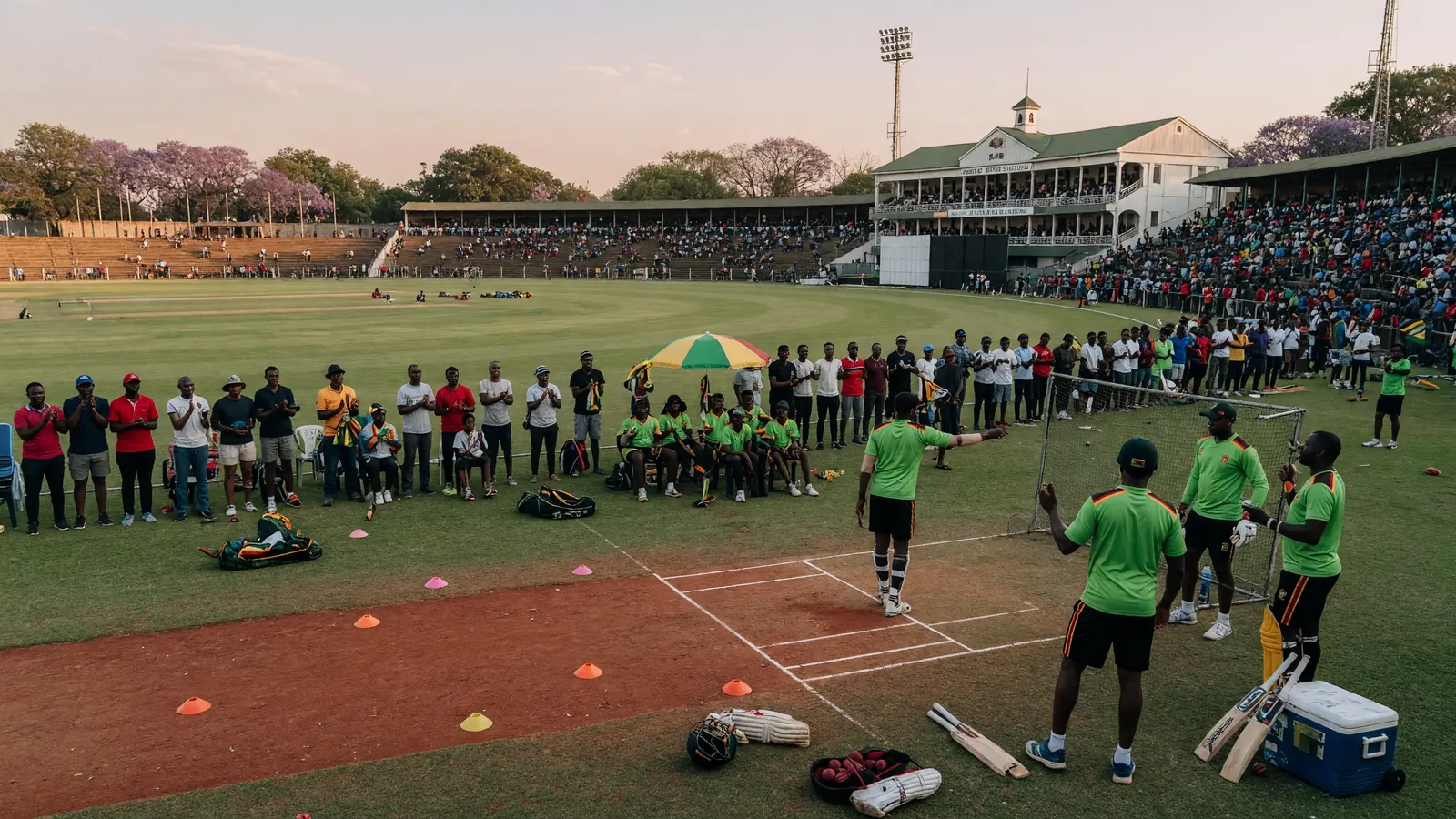
All three T20Is are scheduled at Harare Sports Club, so combinations will be chosen on one home ground.
Harare schedule: three matches, one ground
There is no venue travel puzzle. Every match is at Harare Sports Club:
1st T20I — Wednesday, July 23, 4.30pm IST
2nd T20I — Friday, July 25, 4.30pm IST
3rd T20I — Saturday, July 26, 4.30pm IST
A single-ground series compresses preparation. Net sessions, wicket reads and boundary dimensions stay constant. That usually helps the home side’s fielding patterns and bowling plans if the surface character holds across three games in four days. For India, the lack of travel is a practical plus after a difficult stretch of white-ball cricket; for Zimbabwe, it removes any question about unfamiliar venues inside the series.
The published 4.30pm IST start converts to early afternoon local time in Harare. Both innings are therefore set up as a daytime assignment rather than a late local fixture. That timing detail matters for how the day is planned and for how conditions may evolve across the two innings. New-ball discipline, middle-over control and death-overs clarity remain the same practical themes any short T20 series puts under pressure.
Form snapshot before the first ball
Zimbabwe’s recent block against Bangladesh was split by format. They beat Bangladesh by an innings in a one-off Test and won the ODI series 2-1 in Harare, then lost the T20I series 1-2 in Bulawayo. That sequence explains why the T20 group was adjusted without a wholesale clear-out: longer-format results were strong; the shortest format was not.
India’s recent T20 ledger is weaker on paper. Seven matches without a win — including both games against Ireland and a 4-0 scoreline inside a five-match England series — means every overseas assignment arrives under sharper scrutiny. A trip to Zimbabwe still favours India on pure depth in most previews, but the verified recent record removes any assumption of a casual walkover. The first ten overs on July 23 will be the first public test of how both groups handle that pressure.
None of that requires inventing scores, quotes or selection motives beyond the record. The verified picture is simple: Zimbabwe have reshaped a T20 unit after a home series loss to Bangladesh, while India are hunting a first T20 win in eight attempts under a compressed three-match calendar.
What the changes put on the table
With Madhevere back in the 15, Zimbabwe regain an all-round option who can bat and bowl part-time off spin if selected. Nyamhuri’s fitness restores another pace name after the niggle that kept him out of the Bangladesh T20Is. Tsiga’s presence means Madande is no longer the only route to a specialist keeper-batter profile inside this squad list.
Chivanga retaining his place is the continuity note inside the seam group. Selectors could have rotated him out once Nyamhuri recovered; instead both names remain available across three matches. Brad Evans and Blessing Muzarabani also remain in the published pace mix, while Richard Ngarava continues as a left-arm seam option. Exact new-ball pairs and middle-over combinations are match-day questions, not facts stated in the squad release.
The batting group still includes familiar names such as Marumani, Bennett, Myers, Raza and Burl, with Shumba and Curran among the additional batting options listed. The board has not published a locked order. The open question ahead of the toss is not whether Zimbabwe have batters on paper; it is whether the selected top order can handle India’s new-ball quality long enough for the middle order to settle.
India assignment in context for home supporters
Home series against India remain rare enough on the Zimbabwe calendar that selection news travels well beyond the usual domestic audience. Harare Sports Club will host all three matches against a visiting side stacked with T20 specialists. For local fans, the practical story is less about long historical chapters and more about whether the revised 15 can stay competitive across a short burst without the mid-series reset a longer tour would allow.
Raza’s leadership is the constant. He captained through the Bangladesh T20Is and keeps the armband for India. Continuity there matters when three changes have already altered the supporting cast. Beyond that confirmed captaincy line, the board has not released a public messaging brief about dressing-room themes or role charts, and this report does not invent one.
Readers who want broader match and squad updates beyond this series can follow ongoing cricket coverage via CricFrog cricket news, where series notes and selection briefs are collected as they are confirmed.
Limits of the public brief
Three changes do not automatically erase the issues that contributed to the 1-2 T20 result against Bangladesh. Powerplay wickets, middle-over scoring rate and death-overs control remain the stress points any short series will test again. Madhevere can influence the middle overs only if he is selected and used in a defined role. Nyamhuri’s return helps only if he is fit enough for the intensity of an India top order. Tsiga’s gloves matter only if he is picked and then gathers cleanly under match pressure.
There is also no confirmed public indication, in the source material used for this report, of India’s final XI or of any late Zimbabwe injury beyond Nyamhuri’s resolved niggle. Match-day elevens should be treated as unconfirmed until the toss. The squad list is firm; the playing XI is not. Speculation about batting order preferences, selector motives or internal messaging that go beyond the named 15 is outside the verified record and is omitted here on purpose.
What to watch without overreaching
On a single Harare surface, series results often hinge on repeated skills rather than travel recovery. Reasonable watch-points, framed as questions rather than predictions, include:
How Zimbabwe share the new ball among Ngarava, Nyamhuri, Muzarabani, Evans and Chivanga across three games
Whether Madhevere is selected in the XI and, if so, where he bats and bowls
Whether Tsiga’s maiden call-up becomes a debut during the series or remains a squad-only promotion
Whether India can convert strong positions after a stretch of T20 results that failed to deliver wins
Those are observational frames, not forecasts of margin. The verified facts stop at squad composition, venue, schedule, fitness notes already published, and recent series outcomes. Anything beyond that belongs to the match, not the selection release.
First checkpoint: July 23 at Harare Sports Club
The next concrete event on the calendar is the first T20I on July 23 at Harare Sports Club, starting 4.30pm IST. That match will show which of the available options Zimbabwe actually use, including whether Madhevere and Nyamhuri are in the XI and whether Tsiga’s call-up becomes a debut. Two further games on July 25 and 26 leave almost no gap for major reinvention if the first match goes wrong.
For now, the board has done its part: a 15-man squad, three defined changes, one captain, one ground, three start times. The rest moves from the selection room to the middle at Harare.